

Description


Item Description
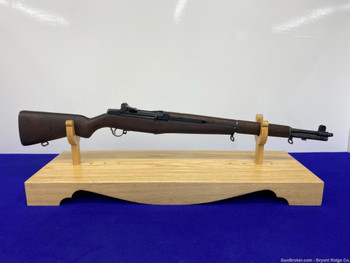
Bryant Ridge Co. is pleased to present this collectible semi-automatic rifle today for a penny-start auction, this is the Harrington & Richardson (H&R) M1 Garand.
As part of a Department of Defense mandate to condition older weapons for war-reserve storage, Marine Corps rebuilds were electro-penciled on the receiver heel with an “O” for overhaul followed by the final two digits of the year the work was completed; examples marked O-64 and O-67 are known, though the majority are marked O-65 or O-66, with O-66 being the most commonly encountered. This heel-applied marking method is distinct from Army rebuild practices and serves as one of the most reliable indicators of a 1960s USMC overhaul. Collectively, these features define the 1960s USMC M1 Garand rebuild and represent one of the few dependable means of confirming Marine Corps provenance, making these rifles especially desirable to collectors as authentic examples of Marine armorers’ craftsmanship and long-term stewardship of the M1 rifle.
This particular M1 Garand exhibits all of the hallmark features of a USMC-overhauled rifle. Stamped “O-65,” it was overhauled in 1965 at the Marine Corps Supply Center in Barstow, California, and it also retains the condition code “Turn-In” hang tag, a signature identifier of Marine Corps maintenance practices. Freedom of Information Act (FOIA) records further confirm that this rifle was part of the USMC inventory, solidifying its Marine Corps provenance. These features confirm its history as a Marine Corps–overhauled service rifle, prepared for both reliability and combat readiness. Its combination of Marine-specific traits makes it a desirable collectible for historians and military firearm enthusiasts.
SPECIFICATIONS:
Manufacturer: Harrington & Richardson (H&R)
Model: M1 Garand “Overhauled by USMC Marine Corps Supply Center, Barstow, Ca”
Serial: 4692458
Date of Manufacture: 1953 (According to https://oldguns.net/sn_php/mildateslookup.php), Overhauled in 1965 “O-65”
Caliber: .30-06
Finish: Parkerized
Barrel Length: 24"
Optics/Sights: Winged Protected Blade Front with Adjustable Aperture Rear
Stock/Grips: Smooth Walnut
Action: Semi-Automatic
Markings: Standard / The rear of the receiver -behind the rear sight- is electro-penciled “O-65”, which indicates it was overhauled in 1965. The rear of the receiver is stamped “U.S.RIFLE / CAL. .30 M1 / H.&R. ARMS CO. / 4692458”. The right side of the barrel -behind the op rod- is stamped “HRA 6535448 5-55 RS52”. The bottom of the pistol grip is stamped with a “P” in a circle.
Bryant Ridge's Analysis:
The M1 Garand, commonly referred to as the M1 rifle, was the first semi-automatic rifle issued as the standard service weapon for the U.S. Army, marking a significant evolution in infantry armament and providing soldiers with unprecedented firepower and rapid follow-up shot capability. It played a crucial role during World War II and the Korean War, where its reliability and effectiveness were repeatedly demonstrated under combat conditions. Chambered in the powerful .30-06 Springfield cartridge, the rifle was designed by Canadian-American engineer John Garand, whose innovative mechanism provided smooth semi-automatic operation while maintaining durability in harsh battlefield environments. The M1 quickly gained a reputation for its robust construction, dependable performance, and overall effectiveness on the battlefield, which earned the admiration of soldiers and commanders alike. Soldiers appreciated its fast, semi-automatic operation, which gave them a significant advantage over opponents armed with bolt-action rifles, and General George S. Patton famously called it "the greatest battle implement ever devised," reflecting its impact on modern infantry tactics. Officially adopted in 1936, production of the M1 Garand increased steadily through the late 1930s, and it became widely issued to U.S. forces by the early 1940s, effectively replacing the bolt-action M1903 Springfield as the standard service rifle. Although officially succeeded by the selective-fire M14 rifle on March 26, 1958, the M1 Garand continued to see limited use in specialized units, reserve formations, and training roles for several years afterward, demonstrating the lasting utility and enduring legacy of this groundbreaking infantry weapon.
Model: M1 Garand “Overhauled by USMC Marine Corps Supply Center, Barstow, Ca”
Serial: 4692458
Date of Manufacture: 1953 (According to https://oldguns.net/sn_php/mildateslookup.php), Overhauled in 1965 “O-65”
Caliber: .30-06
Finish: Parkerized
Barrel Length: 24"
Optics/Sights: Winged Protected Blade Front with Adjustable Aperture Rear
Stock/Grips: Smooth Walnut
Action: Semi-Automatic
Markings: Standard / The rear of the receiver -behind the rear sight- is electro-penciled “O-65”, which indicates it was overhauled in 1965. The rear of the receiver is stamped “U.S.RIFLE / CAL. .30 M1 / H.&R. ARMS CO. / 4692458”. The right side of the barrel -behind the op rod- is stamped “HRA 6535448 5-55 RS52”. The bottom of the pistol grip is stamped with a “P” in a circle.
Bryant Ridge's Analysis:
The M1 Garand, commonly referred to as the M1 rifle, was the first semi-automatic rifle issued as the standard service weapon for the U.S. Army, marking a significant evolution in infantry armament and providing soldiers with unprecedented firepower and rapid follow-up shot capability. It played a crucial role during World War II and the Korean War, where its reliability and effectiveness were repeatedly demonstrated under combat conditions. Chambered in the powerful .30-06 Springfield cartridge, the rifle was designed by Canadian-American engineer John Garand, whose innovative mechanism provided smooth semi-automatic operation while maintaining durability in harsh battlefield environments. The M1 quickly gained a reputation for its robust construction, dependable performance, and overall effectiveness on the battlefield, which earned the admiration of soldiers and commanders alike. Soldiers appreciated its fast, semi-automatic operation, which gave them a significant advantage over opponents armed with bolt-action rifles, and General George S. Patton famously called it "the greatest battle implement ever devised," reflecting its impact on modern infantry tactics. Officially adopted in 1936, production of the M1 Garand increased steadily through the late 1930s, and it became widely issued to U.S. forces by the early 1940s, effectively replacing the bolt-action M1903 Springfield as the standard service rifle. Although officially succeeded by the selective-fire M14 rifle on March 26, 1958, the M1 Garand continued to see limited use in specialized units, reserve formations, and training roles for several years afterward, demonstrating the lasting utility and enduring legacy of this groundbreaking infantry weapon.
U.S. Marine Corps–rebuilt M1 Garand rifles reflect the Corps’ methodical approach to sustaining legacy service rifles following World War II and the Korean War, with three major rebuild programs conducted immediately after World War II, after the Korean War, and most notably during the mid-1960s. While earlier rebuilds exhibit few distinguishing Marine Corps traits, rifles overhauled between 1964 and 1967 display several identifiable characteristics that firmly establish USMC provenance. Many of these rifles were processed at Marine Corps Service Centers at Albany and Barstow, and are documented with the commonly encountered condition code “Turn-In” tags. Finishes were typically refreshed with a uniform light grey zinc-phosphate parkerizing, along with rear sights, bases, and sight aprons, which were frequently blackened to reduce glare, a practice consistent with earlier USMC M1903 rebuilds. Stocks and handguards were commonly sanded during overhaul, resulting in a slightly rough texture, and may bear rebuild markings such as a letter stamped into the pistol grip denoting where the work took place. Many rifles also typically retain DOPE tags affixed inside the trigger housing, handwritten or typewritten, and in some cases identifying the Marine to whom the rifle was issued.
As part of a Department of Defense mandate to condition older weapons for war-reserve storage, Marine Corps rebuilds were electro-penciled on the receiver heel with an “O” for overhaul followed by the final two digits of the year the work was completed; examples marked O-64 and O-67 are known, though the majority are marked O-65 or O-66, with O-66 being the most commonly encountered. This heel-applied marking method is distinct from Army rebuild practices and serves as one of the most reliable indicators of a 1960s USMC overhaul. Collectively, these features define the 1960s USMC M1 Garand rebuild and represent one of the few dependable means of confirming Marine Corps provenance, making these rifles especially desirable to collectors as authentic examples of Marine armorers’ craftsmanship and long-term stewardship of the M1 rifle.
Contents:
This example will ship with all the paperwork pictured above.
Return Policy:
We gladly offer a 3-day unfired inspection policy from the time that the firearm is delivered to your FFL. Refunds are available for all qualifying orders.



Shipping Details
Handgun Standard Shipping with Insurance $50.00
Long Gun Standard Shipping with Insurance $70.00
Any orders placed with magazines that are not compliant with your state, county, or city regulations will not ship with your order.
We strive to ship orders within the close of the following business day after payment and documentation is received.
Payment Details
We accept all forms of Payment including Personal Check, Business Check, PO Money Orders, Certified Check, Etc.
Please note we place a 7 business day hold on shipment, for all non-certified payments.
Payment MUST be received within 14 days.
Return Policy
We gladly offer a 3 day unfired inspection policy from the time that the firearm is delivered to your FFL. Refunds are available for all qualifying orders.
Additional Details
Our #1 priority is customer satisfaction. We want to build a lasting trust in the relationship with our customers, so that you will always look to us for all your firearms needs. If you have any issues with your transactions please contact us, and we will work with you to resolve any issues you may have. We greatly appreciate your trust in us and we look forward to fulfilling all your future firearm needs.
Bryant Ridge also reserves the right to cancel any sales that may occur while gunbroker.com is experiencing technical issues that affects the entire site or a complete site outage, within an hour of the auction ending.
We have an amazing inventory of classic and collector firearms that we are adding to Gunbroker daily. Stay up to date on all of our latest auction by adding us to your favorite sellers list.
About Us
From a small town hobby, to a leader in the investment and collector grade firearms industry. Bryant Ridge Firearms is here to offer the best in quality and customer service when you are looking to unload your collector grade firearm collection. 
Additional Information
GunbrokerLink: |
https://www.gunbroker.com/item/1154526237 |
BidPrice: |
0.01 |
AuctionEndDate: |
2026-02-15 22:00:00 |
CurrentBid: |
1475 |
SoldOutTime: |
2026-02-15 17:02:06 |