

Description

Item Description
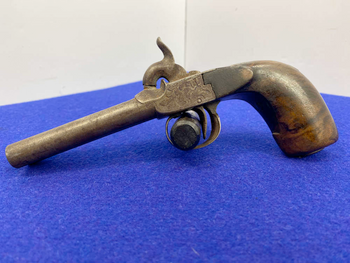
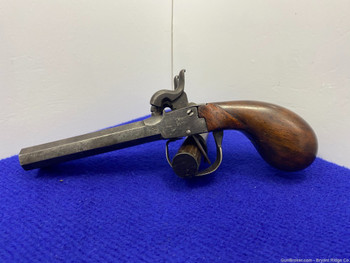
Bryant Ridge Co. is pleased to present this side-by-side pistol for a penny start auction, this is an unknown model of a Belgian Double-Barreled Percussion Boot Pistol.
Please note, this example is in non-functional condition; it appears one of the hammers has been broken off, and the other one will not stay in the “cocked” position.
SPECIFICATIONS:
Manufacturer: Unknown
Model: Belgian Double-Barreled Percussion Boot Pistol
Serial: No Serial
Caliber: Commonly Chambered for .44 Caliber Round Ball
Finish: Blue
Barrel Length: 3.5"
Optics/Sights: Rear Notch
Stock/Grips: Smooth Wood Grips
Action: Side By Side
Markings: Standard
Bryant Ridge's Analysis:
An unknown model of a Belgian double-barreled percussion boot pistol represents a fascinating example of mid-19th-century European pocket arms, combining compact concealability with increased close-range lethality. These pistols were most commonly produced in Belgium, particularly in and around the city of Liège, a major international firearms-manufacturing center regulated by the Liège Proof House. Typically dating from the 1840s to the 1860s, such pistols were intended for discreet civilian self-defense at a time when reliable repeating firearms were not yet widely available. The double-barrel configuration—often arranged side-by-side or over-and-under—allowed the user to fire two shots before reloading, a significant advantage in an emergency. These pistols were usually smoothbore, chambered for round ball or shot in calibers ranging roughly from .28 to .36, and loaded with loose black powder and percussion caps placed individually on each nipple. The percussion ignition system marks the transitional period between earlier flintlock designs and later metallic cartridge firearms. Construction was generally utilitarian, with iron or steel barrels and frame, a simple hinged or fixed breech, and a compact bird’s-head or saw-handle grip typically made of walnut. Decorative elements such as light engraving on the breech or tang were common, though many examples were left largely plain to keep costs low. Often unmarked or bearing only small proof stamps, these pistols are difficult to attribute to a specific maker, reflecting the cottage-industry nature of Belgian arms production at the time. Today, an unidentified Belgian double-barreled percussion boot pistol is valued primarily for its historical character, illustrating the ingenuity and practicality of 19th-century personal defense weapons and the important role Belgium played in supplying affordable firearms to the global market.
Return Policy:
We gladly offer a 3 day unfired inspection policy from the time that the firearm is delivered to your FFL. Refunds are available for all qualifying orders.
Model: Belgian Double-Barreled Percussion Boot Pistol
Serial: No Serial
Caliber: Commonly Chambered for .44 Caliber Round Ball
Finish: Blue
Barrel Length: 3.5"
Optics/Sights: Rear Notch
Stock/Grips: Smooth Wood Grips
Action: Side By Side
Markings: Standard
Bryant Ridge's Analysis:
An unknown model of a Belgian double-barreled percussion boot pistol represents a fascinating example of mid-19th-century European pocket arms, combining compact concealability with increased close-range lethality. These pistols were most commonly produced in Belgium, particularly in and around the city of Liège, a major international firearms-manufacturing center regulated by the Liège Proof House. Typically dating from the 1840s to the 1860s, such pistols were intended for discreet civilian self-defense at a time when reliable repeating firearms were not yet widely available. The double-barrel configuration—often arranged side-by-side or over-and-under—allowed the user to fire two shots before reloading, a significant advantage in an emergency. These pistols were usually smoothbore, chambered for round ball or shot in calibers ranging roughly from .28 to .36, and loaded with loose black powder and percussion caps placed individually on each nipple. The percussion ignition system marks the transitional period between earlier flintlock designs and later metallic cartridge firearms. Construction was generally utilitarian, with iron or steel barrels and frame, a simple hinged or fixed breech, and a compact bird’s-head or saw-handle grip typically made of walnut. Decorative elements such as light engraving on the breech or tang were common, though many examples were left largely plain to keep costs low. Often unmarked or bearing only small proof stamps, these pistols are difficult to attribute to a specific maker, reflecting the cottage-industry nature of Belgian arms production at the time. Today, an unidentified Belgian double-barreled percussion boot pistol is valued primarily for its historical character, illustrating the ingenuity and practicality of 19th-century personal defense weapons and the important role Belgium played in supplying affordable firearms to the global market.
Return Policy:
We gladly offer a 3 day unfired inspection policy from the time that the firearm is delivered to your FFL. Refunds are available for all qualifying orders.



Shipping Details
Handgun Standard Shipping with Insurance $50.00
Long Gun Standard Shipping with Insurance $70.00
Any orders placed with magazines that are not compliant with your state, county, or city regulations will not ship with your order.
We strive to ship orders within the close of the following business day after payment and documentation is received.
Payment Details
We accept all forms of Payment including Personal Check, Business Check, PO Money Orders, Certified Check, Etc.
Please note we place a 7 business day hold on shipment, for all non-certified payments.
Payment MUST be received within 14 days.
Return Policy
We gladly offer a 3 day unfired inspection policy from the time that the firearm is delivered to your FFL. Refunds are available for all qualifying orders.
Additional Details
Our #1 priority is customer satisfaction. We want to build a lasting trust in the relationship with our customers, so that you will always look to us for all your firearms needs. If you have any issues with your transactions please contact us, and we will work with you to resolve any issues you may have. We greatly appreciate your trust in us and we look forward to fulfilling all your future firearm needs.
Bryant Ridge also reserves the right to cancel any sales that may occur while gunbroker.com is experiencing technical issues that affects the entire site or a complete site outage, within an hour of the auction ending.
We have an amazing inventory of classic and collector firearms that we are adding to Gunbroker daily. Stay up to date on all of our latest auction by adding us to your favorite sellers list.
About Us
From a small town hobby, to a leader in the investment and collector grade firearms industry. Bryant Ridge Firearms is here to offer the best in quality and customer service when you are looking to unload your collector grade firearm collection.